Which lane do you use to turn right at a roundabout?
Use the right-hand lane, unless signs or markings say otherwise. Check your mirrors and signal right as you approach, then keep to the right on the roundabout. Once you have passed the exit before yours, check your mirrors, especially the left one, in case a car is alongside you, then signal left and move across only when it is safe.
You know the rule. Can you spot it on the road?
Try it in a free scene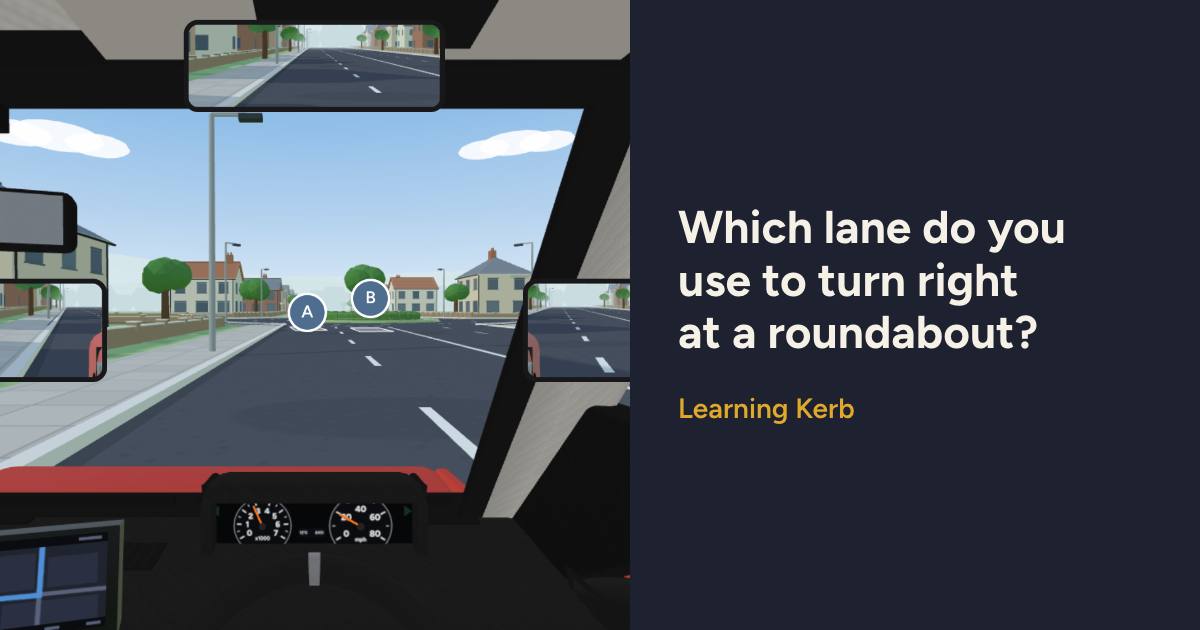
Why the left-hand lane goes wrong
If you are told to turn right, third exit, you are going a long way round, and the left-hand lane puts you on the wrong side of the roundabout for it. To get round from there you would have to cross other traffic. DVSA gives the example of a learner who uses the left-hand lane when it is not appropriate, carries on round in it, and confuses several vehicles behind.
Lane markings and signs come first, so read them on the approach. Some roundabouts direct you differently, which is why the Highway Code says to act on all the information available to you and to decide on your exit as early as possible.
Leaving is where it gets dangerous
Going round in the right-hand lane usually leaves you with one last job: moving across to your exit. Where lane markings lead you off, follow them. Otherwise any vehicle in the lane on your left is now in your way, and it may be heading for the same exit. Changing lanes on a multi-lane roundabout without mirror checks is a mistake that counts, and so is trying to change lane with a vehicle directly alongside you.
So check your mirrors, especially the left one, before you signal left and before you move, every time. If a car is beside you and the exit has two lanes, you do not need to get in front of it or drop behind it. Keep your lane through the exit and sort out your position once you are clear. If the exit has only one lane, stay in your lane and let the car go ahead, and if that means missing your exit, carry on round. Speeding up to beat it, or signalling and hoping it makes room, forces it to brake or swerve.
Keep watching for others as you go. You should give priority to cyclists on the roundabout, who may stay in the left-hand lane while they continue round. Motorcyclists and long vehicles need plenty of room, and pedestrians may be crossing the exit road.
How we mark each mistake
Practice marks only: on a real test, the examiner decides. How faults work.
You cut across a car you had not seen Dangerous fault
A car was alongside in the outer lane when you moved across to leave. Check your mirrors, especially the left one, before changing position to exit.
You cut across the car beside you Dangerous fault
Moving across the lane on your left with a car there forces it to brake or swerve. Where the exit has two lanes, keep your lane through the exit and sort out your position once you are clear. Where it has one, let the car go ahead.
Wrong lane for turning right Serious fault
To take an exit to the right, signal right and approach in the right-hand lane unless signs or markings say otherwise. From the left-hand lane you would have to cross traffic to get round.
What the Highway Code says
- Rule 184:
decide as early as possible which exit you need to take
- Rule 186:
signal right and approach in the right-hand lane
- Rule 187:
traffic crossing in front of you on the roundabout, especially vehicles intending to leave by the next exit
MUST and MUST NOT are the law. Should is advice, which can still be used in evidence in court.
Where this fits on the test
Top 10 fail reasons: not using mirrors correctly when changing direction, incorrect positioning when turning right at junctions, not responding correctly to road markings. DVSA driving skills: Roundabouts.