How do you turn right at a mini-roundabout on your driving test?
Check your mirrors and signal right as you approach, give way to traffic coming from your right, then drive round the white circle, keeping it on your right. Treat it as a roundabout, even though it is only paint: you MUST go round the central marking, never over it or in front of it.
You know the rule. Can you spot it on the road?
Try it in a free scene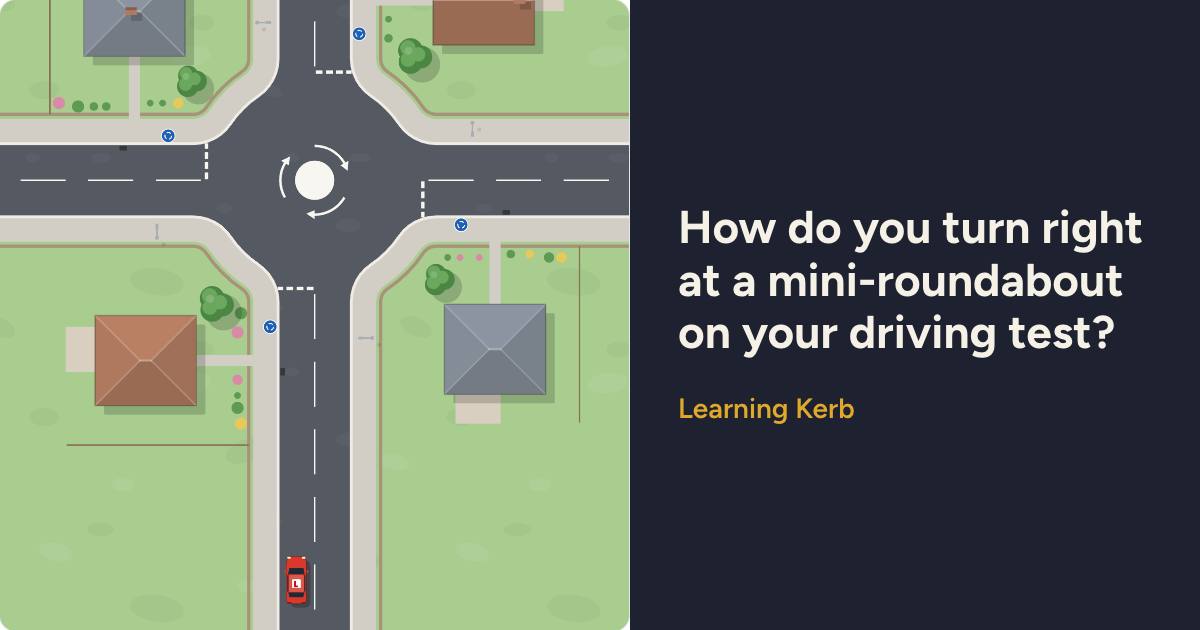
Why mini-roundabouts catch learners out
A mini-roundabout is small and the middle is only paint, so it is easy to treat it as an ordinary junction. You approach it in the same way as any roundabout, but everything happens in less space, and you have less time to signal and to see what other drivers will do.
The hardest part is judging the gap. Before you go, look at how far away the next vehicle on your right is. If you would make it slow down, you have gone too soon. Look ahead and left too, because someone may already be on the roundabout or making a U-turn. If you can see it is clear all round, you do not need to stop at the line, as waiting for no reason can hold up and confuse others.
What to do, step by step
Take it in this order as you come to the give way line:
- Check your mirrors, signal right in good time, and keep just left of the centre line, or use the right-hand lane if there are two.
- Slow down early and look right as you get closer.
- Give way to anything coming from your right.
- When there is a safe gap, go round the white circle, keeping it on your right.
- Once you have passed the exit before yours, check your mirror, then signal left if there is time to do it without confusing anyone, and leave.
How we mark each mistake
Practice marks only: on a real test, the examiner decides. How faults work.
You pulled out right in front of traffic from the right Dangerous fault
You should give priority to traffic approaching from your right. Going that close in front of a vehicle makes it brake hard, or puts you in its path.
You went the wrong way round Serious fault
You MUST pass round the central marking of a mini-roundabout. Turning right in front of it takes you the wrong way round, across the path of traffic coming from your right.
You drove over the central marking Serious fault
You MUST pass round the central marking of a mini-roundabout, unless your vehicle is too big to. A car can always go round it, keeping it on your right.
You pulled out in front of traffic from the right Serious fault
You should give priority to traffic approaching from your right. A vehicle was too close for you to go without making it slow down for you.
You did not signal Driving fault
To turn right you should signal right as you approach. A mini-roundabout gives other drivers less time to see what you are doing, so the signal matters more, not less.
Your signal came too late Driving fault
You should signal right as you approach, after checking your mirrors. At a mini-roundabout there is less time to signal, so a signal given at the line tells others too little, too late.
You waited too long Driving fault
There was a safe gap, and later a clear road, but you did not go. Waiting for no reason can hold up and confuse others.
What the Highway Code says
- Rule 184:
use Mirrors – Signal – Manoeuvre at all stages
- Rule 185:
give priority to traffic approaching from your right, unless directed otherwise by signs, road markings or traffic lights
- Rule 186:
signal right and approach in the right-hand lane
- Rule 188:
All vehicles MUST pass round the central markings except large vehicles which are physically incapable of doing so.
MUST and MUST NOT are the law. Should is advice, which can still be used in evidence in court.
Where this fits on the test
Top 10 fail reasons: not making effective observations at junctions, not responding correctly to road markings. DVSA driving skills: Roundabouts, Signals, Other traffic.