How do you emerge from a blind junction?
At a blind junction, edge forward slowly until you can see past whatever is blocking your view, then go only when there is a gap large enough to join safely. You MUST give way to traffic on the main road when emerging from a junction with broken white lines, and you cannot give way to something you cannot see.
You know the rule. Can you spot it on the road?
Try it in a free scene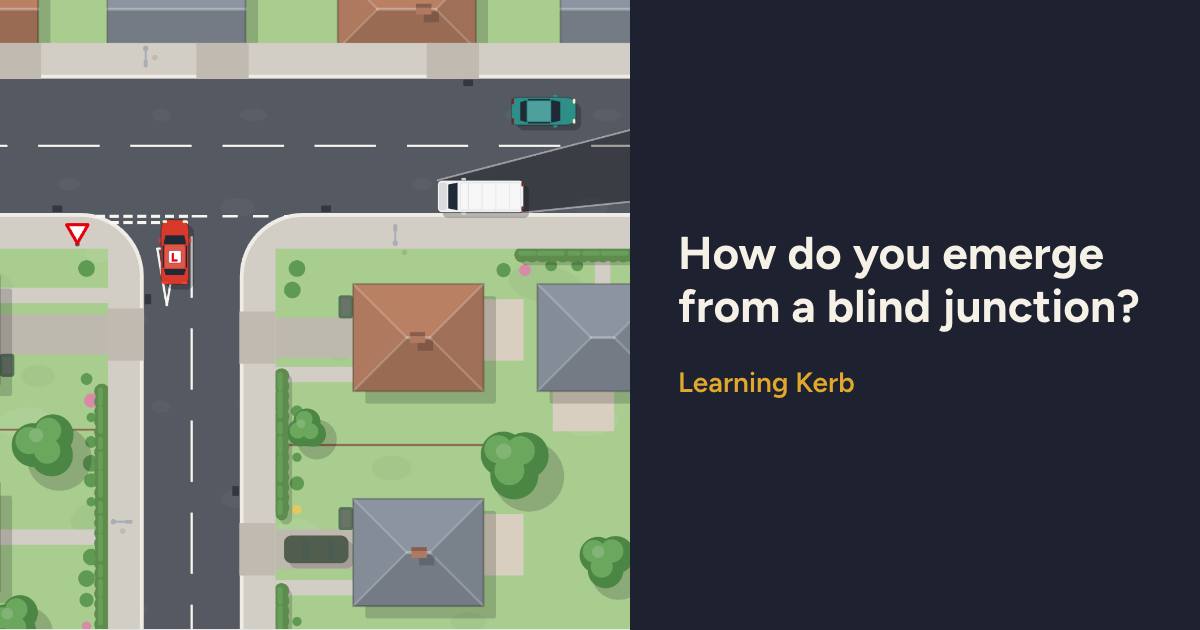
What a parked van can hide from you
A van parked close to a junction makes it a blind one, hiding part of the main road from your side road. You can look right, see an empty stretch and still have no idea what is behind the van. A motorcyclist can stay hidden there until the last moment, and the Highway Code warns that they could be approaching faster than you think.
The usual mistake is to treat what you can see as all there is. An empty stretch of road tells you nothing about the part you cannot see, so you have not finished looking until you can see past the van.
How to edge forward safely
Think of this as looking in stages. Creeping forward gives you a view. It does not give you priority, and traffic on the main road still comes first.
- Come up to the line and look both ways. If there is a Stop sign and a solid white line, you MUST stop behind the line first.
- If your view is blocked, let the car creep forward very slowly, looking past the van as the view opens up. Go no further than you need to see, and be ready to stop at once.
- Look for motorcyclists and cyclists as well as cars.
- Go only when you have looked both ways and the gap is large enough to join safely.
Looking too late, or waiting too long
DVSA lists looking too late as a mistake in its own right: by the time you look, you are already partly into the next road. So keep looking the whole way forward, and decide to go only once you have a proper view.
The opposite error is staying put. Once you can see that the road is clear both ways, go. Sitting at the line after that only delays the drivers behind you.
How we mark each mistake
Practice marks only: on a real test, the examiner decides. How faults work.
You pulled out on a motorcyclist Dangerous fault
The rider was too close to stop safely. You MUST give way to traffic on the main road. Motorcyclists are hard to spot at junctions, so look for them and wait until they have passed.
You pulled out without seeing Serious fault
A motorcyclist was hidden behind the van and had to brake for you. You MUST give way to traffic on the main road, so edge forward until you can see before you commit.
You waited too long Driving fault
The road was clear in both directions for several seconds. Waiting when it is safe to go holds up the traffic behind you.
What the Highway Code says
- Rule 170:
look all around before emerging. Do not cross or join a road until there is a gap large enough for you to do so safely.
- Rule 172:
You MUST give way to traffic on the main road when emerging from a junction with broken white lines across the road.
- Rule 211:
Always look out for them before you emerge from a junction; they could be approaching faster than you think.
MUST and MUST NOT are the law. Should is advice, which can still be used in evidence in court.
Where this fits on the test
Top 10 fail reason: not making effective observations at junctions. DVSA driving skills: Junctions.