Should you turn offside to offside at a crossroads?
Where the junction allows it, yes. Turning right side to right side, often called offside to offside, means keeping the other vehicle on your right and turning behind it. The Highway Code calls this generally the safer method, because you have a clear view of approaching traffic as you finish your turn. Road layout, markings or where the other vehicle has stopped can decide it instead.
You know the rule. Can you spot it on the road?
Try it in a free scene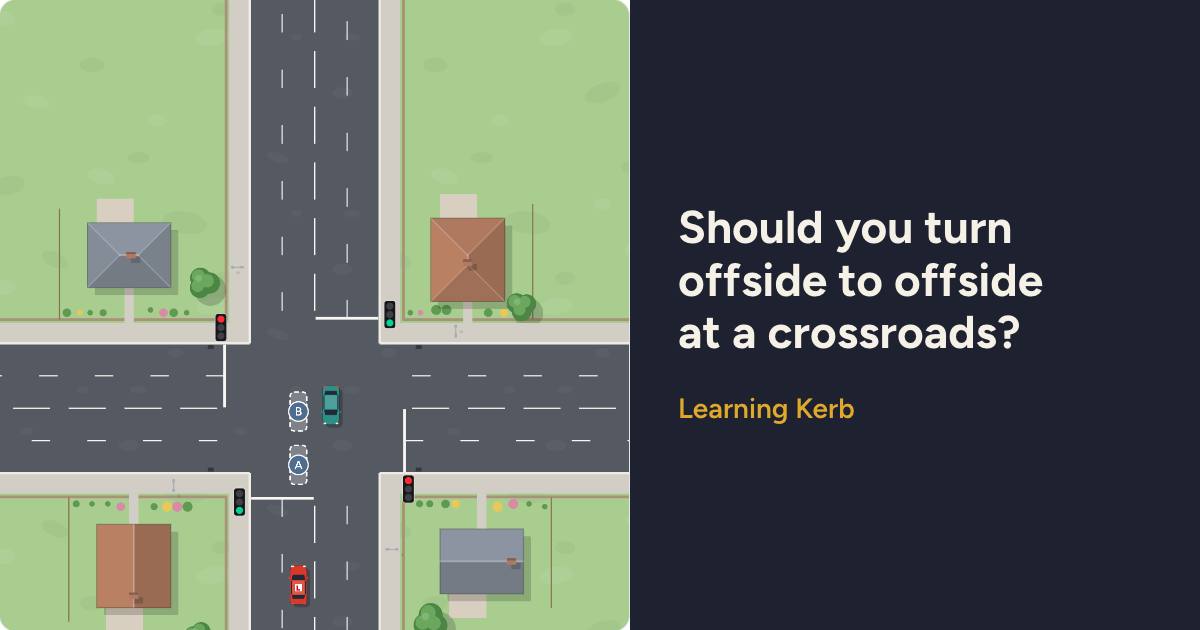
The two ways two cars can turn right
When you and an oncoming driver both want to turn right, the Highway Code gives a choice of two methods:
- Right side to right side: you pass each other, keep the other vehicle on your right, and turn behind it.
- Left side to left side: you turn in front of each other. This can block your view of oncoming vehicles, and cyclists and motorcyclists in particular may be hidden from you, so take extra care.
How to tell which one the junction wants
Neither method is wrong in itself, and that is what confuses people. The answer comes from the road in front of you. Look at the layout, any markings, and exactly where the other driver has stopped.
If they have already pulled forward to pass right side to right side, follow their lead. Turning in front of them blocks their way and your own view, and you can end up stuck in the junction. If they are already placed to turn in front of you, or the layout or markings leave no room to go behind them, turn left side to left side and take extra care, because your view may be blocked.
Passing behind the other car is not the end of it
Going behind the other car gives you a view. You still have to use it. Wait until there is a safe gap between you and any oncoming vehicle, and watch for anything smaller following a larger vehicle. A motorcyclist behind a van is easy to miss, so let it pass, and start the turn only when there is a safe gap. A green light does not change this, because the oncoming traffic may have a green light too.
Then go when it is clear. Sitting in the middle of the junction once the oncoming lane is empty leaves you there longer than you need to be.
How we mark each mistake
Practice marks only: on a real test, the examiner decides. How faults work.
You turned in front of the van Dangerous fault
The oncoming van was too close for you to turn in front of it. Wait until there is a safe gap between you and any oncoming vehicle before you turn.
You turned across a motorcyclist Dangerous fault
A motorcyclist was following the van, and you turned across their path. Motorcyclists are easy to miss behind other traffic, so look for them and let them pass before you turn.
You turned into the other car’s path Serious fault
Turning left side to left side can work, but this driver had already pulled forward to pass right side to right side. Turning in front of them blocked their way and your view of oncoming traffic, so you were left stuck in the junction.
You turned before the road was clear Serious fault
You got across, but you started to turn while the oncoming traffic was still coming, and only just missed the motorcyclist. Wait until the van and the motorcyclist have gone past you before you turn.
You waited too long Driving fault
The oncoming lane was clear for several seconds. Waiting in the middle of the junction when it is safe to go leaves you there longer than you need to be.
What the Highway Code says
- Rule 179:
take up a position just left of the middle of the road or in the space marked for traffic turning right
- Rule 180:
Wait until there is a safe gap between you and any oncoming vehicle. Watch out for cyclists, motorcyclists, pedestrians and other road users.
- Rule 181:
Road layout, markings or how the other vehicle is positioned can determine which course should be taken.
MUST and MUST NOT are the law. Should is advice, which can still be used in evidence in court.
Where this fits on the test
Top 10 fail reasons: incorrect positioning when turning right at junctions, not making effective observations at junctions. DVSA driving skills: Junctions.