How do you turn right into a side road on your driving test?
Check your mirrors, signal right, and position just left of the middle of the road, leaving room for traffic to pass on your left if possible. Wait there until there is a safe gap in the oncoming traffic and nobody is crossing the side road. Then make the turn in one go, without cutting the corner.
You know the rule. Can you spot it on the road?
Try it in a free scene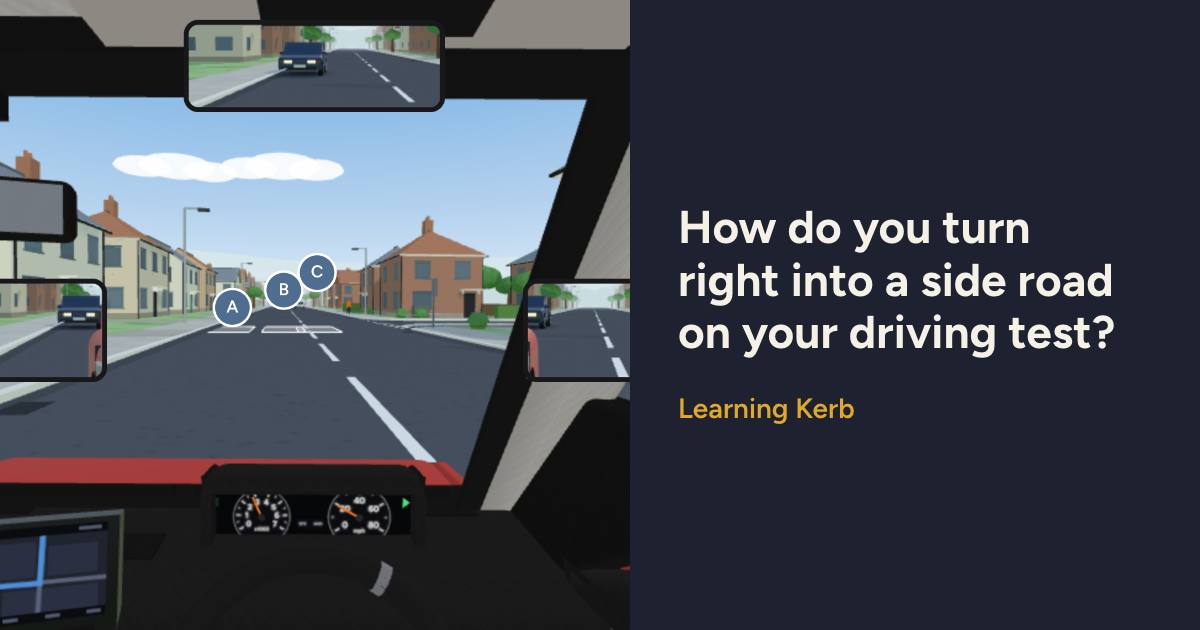
Where to wait for the gap
Your position does two jobs. It shows other drivers where you are going, and it lets them get past you. DVSA asks you to position the car as close to the centre of the road as is safe.
Learners tend to get this wrong in one of two ways. Staying near the left-hand kerb hides what you are doing and can hold up everyone behind you, even on a road wide enough for them to pass. Creeping over the centre line, ready to go, puts you in the path of oncoming traffic. Waiting just left of the middle gives you no priority over that traffic, so stay there until your way is clear. Where there is a space marked for traffic turning right, wait in that instead.
A gap in the traffic is only half the check
Before you go, picture where the car will be a few seconds later. You are looking for two things at once: a safe gap in the oncoming traffic, and a clear side road. Watch for cyclists and motorcyclists in that gap as well, as they are not always easy to see. You should give way to anyone crossing, or waiting to cross, the road you are turning into, and if they have started to cross they have priority.
If someone is about to cross, let the gap go and wait where you are. Turning anyway and stopping part-way leaves you stranded across the oncoming lane.
When both are clear, check your mirrors and blind spot again to make sure you are not being overtaken, then turn. Steer at the right moment too. Steering late can leave you on the wrong side of the new road, so aim to follow the turn cleanly without cutting the corner.
How we mark each mistake
Practice marks only: on a real test, the examiner decides. How faults work.
You turned into a pedestrian Dangerous fault
Someone was stepping out to cross the side road. At a junction you should give way to pedestrians crossing, or waiting to cross, a road you are turning into.
You stopped across the oncoming lane Dangerous fault
Turning before your way was clear left you stranded in the path of an oncoming car, which had to brake hard. Wait in your turning position until you can complete the turn in one go.
Wrong position to turn right Serious fault
Waiting by the left-hand kerb hides your intention and blocks the traffic behind. Position just left of the middle of the road so others can pass on your left.
You crossed the centre line Serious fault
Waiting over the centre line puts you in the path of oncoming traffic. Stay just left of the middle of the road until your way is clear.
What the Highway Code says
- Rule 179:
take up a position just left of the middle of the road or in the space marked for traffic turning right
- Rule 180:
Wait until there is a safe gap between you and any oncoming vehicle.
- Rule 170:
If they have started to cross they have priority, so give way (see Rule H2)
- Rule H2:
At a junction you should give way to pedestrians crossing or waiting to cross a road into which or from which you are turning.
MUST and MUST NOT are the law. Should is advice, which can still be used in evidence in court.
Where this fits on the test
Top 10 fail reasons: incorrect positioning when turning right at junctions, not making effective observations at junctions. DVSA driving skills: Junctions.