Can you use a bus lane on your driving test?
Yes, but only outside the hours shown on its sign, and if it shows no times the lane operates at all times. While it is in operation you should not drive in it unless the sign shows your vehicle is allowed, even when your own lane is queuing. Check the day and the time against the sign.
You know the rule. Can you spot it on the road?
Try it in a free scene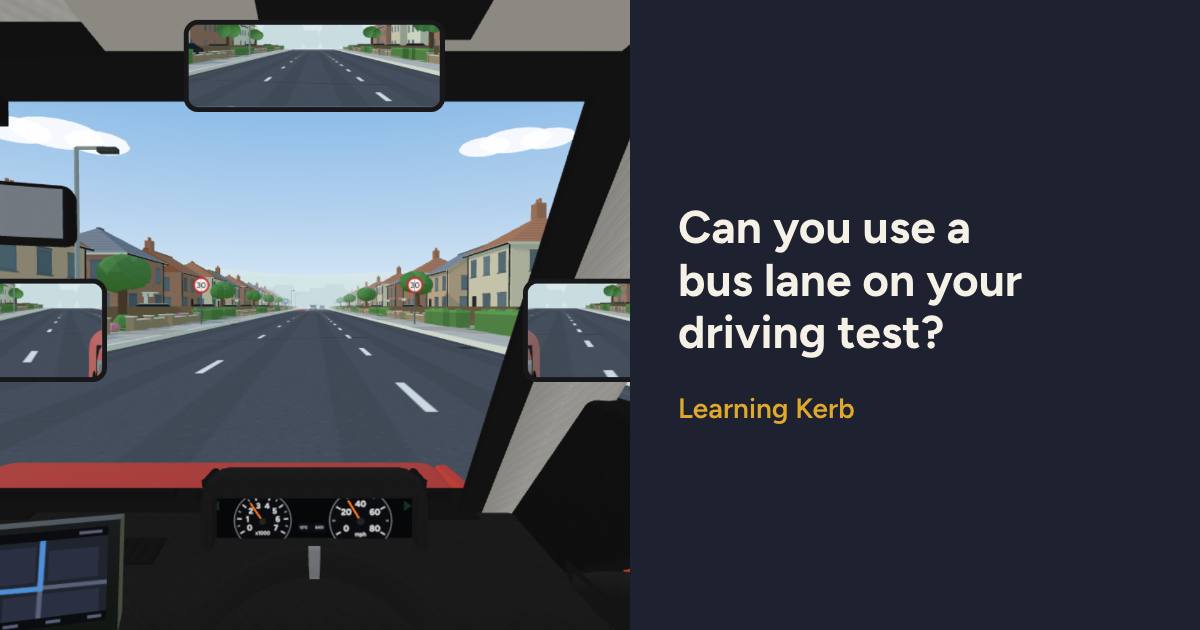
How to read a bus lane sign
A bus lane sign tells you which other vehicles, if any, may use the lane, and it may show when the lane is in operation. Where no times are shown, it operates at all times. A sign reading Mon–Sat, 7 am–7 pm gives both days and hours, so check both. At 5:15 pm on a Tuesday that lane is in operation. Outside those times, any vehicle may use it. A bank holiday makes no difference: if it falls on a day the sign covers, the lane operates as normal.
A queue in your own lane does not alter any of this. Rule 141 words it as should not, and bus lanes are still enforced: you can be sent a penalty charge for driving in one during its hours. DVSA lists driving in a bus lane when a sign shows you cannot use it at that time among its examples of not responding to traffic signs.
Read the sign early enough to choose. Sitting across the lane line while you make up your mind leaves other drivers unsure what you are doing, so stay in one lane.
Which vehicles the sign may allow
Signs differ, so read the one in front of you. Some also show pedal cycles, solo motorcycles or taxis. With the word local, the only buses allowed are those running a local service. Without it, the lane is open to local buses and to any vehicle designed to carry 10 or more people, including the driver. If your car is not covered, stay out while the lane is in operation.
You may enter a bus lane to stop, or to load or unload, where this is not prohibited. Signs alongside the lane will say if it is.
Speed limit signs need the same early reading
A new speed limit applies from the sign, so if you are doing 40 and a 30 sign is coming up, ease off in time to be at 30 as you reach it. You MUST NOT exceed the limit, and keeping up with the traffic around you is no defence.
How we mark each mistake
Practice marks only: on a real test, the examiner decides. How faults work.
You were late slowing for the limit Serious fault
You passed the sign well above 30. You MUST NOT exceed the limit, and it applies from the sign, so act on signs in good time.
You broke the speed limit Serious fault
Keeping up with other traffic is no defence. You MUST NOT exceed the maximum speed limit for the road.
You drove in a bus lane during its hours Serious fault
At 5:15 pm on a Tuesday the lane was in operation. Check the times on the sign before using a bus lane.
You straddled two lanes Driving fault
Sitting across the lane line leaves other drivers unsure what you are doing. Read the sign early and stay in one lane.
What the Highway Code says
Where this fits on the test
Top 10 fail reasons: not responding correctly to traffic signs, not driving at a safe and reasonable speed. DVSA driving skills: Use of speed, Independent driving.