How do you change lanes safely on a dual carriageway?
Check your interior mirror and the door mirror on the side you are moving to, then take a quick sideways glance towards the lane you want. If it is clear, signal and move over. If someone is there or coming up, stay in your lane until they have passed. Make sure you will not force anyone to change course or speed.
You know the rule. Can you spot it on the road?
Try it in a free scene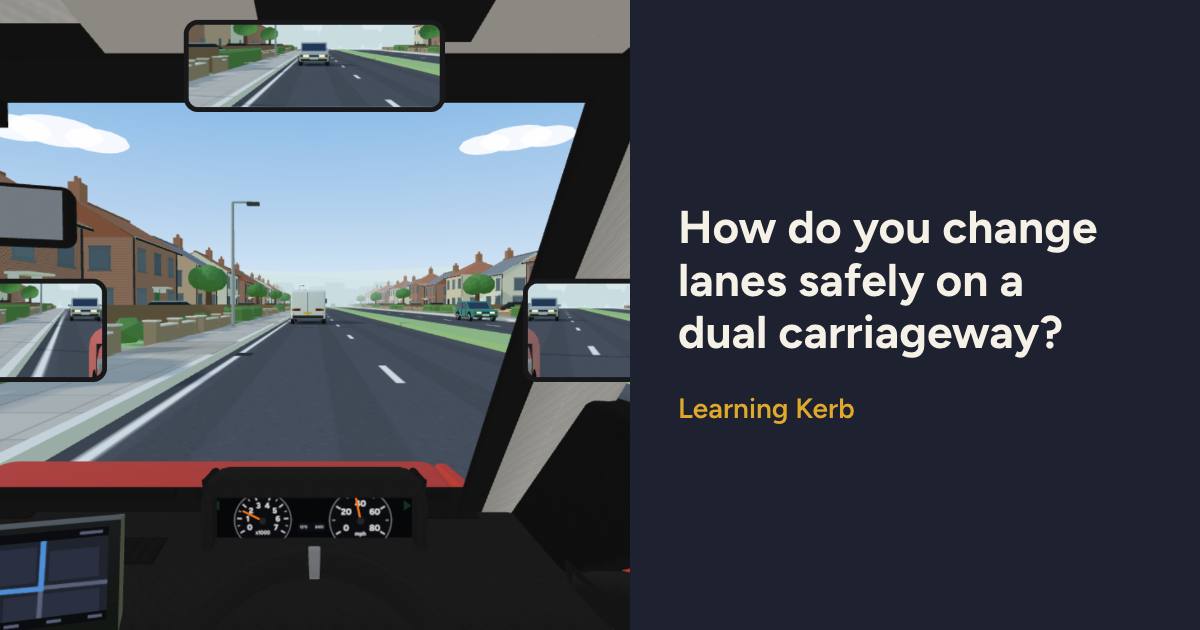
Look first, signal second
Rule 133 puts the looking before the signalling: mirrors, a sideways glance if necessary, then a signal, then the move once it is clear. It is easy to run the looking and the signal together and flick the indicator on as you look up at the mirror. Checking mirrors after or at the same time as signalling is a common fault, and Rule 161 says to use your mirrors in good time before you signal.
The glance covers what the mirrors do not. A car close to your rear door may not appear in any mirror, even when it is right there in the next lane. Keep the glance quick, because you are still moving towards whatever is ahead of you.
A signal does not make a space
A signal says what you would like to do. It gives you no priority. DVSA’s own example here is a driver who checks the mirrors, sees a vehicle approaching in the lane they want, starts to change lanes anyway and makes that vehicle slow down. That counts under not using mirrors correctly when changing direction, second in DVSA’s top 10 reasons for failing.
Once you have passed, think about moving back. Driving in the right-hand lane unnecessarily for a long time is an example of poor positioning.
When the lane you want is busy
You have three choices, and only the first one leaves everyone else alone:
- Stay in your lane, ease off gently if you are closing on the vehicle ahead, let the other car go past, then signal and move out.
- Move across anyway and expect it to drop back. This forces it to change speed.
- Brake firmly to drop in behind it. On a fast road this makes the driver behind you slow suddenly.
How we mark each mistake
Practice marks only: on a real test, the examiner decides. How faults work.
You moved into a car you had not seen Dangerous fault
A car was in your blind spot in the right-hand lane. Use your mirrors and take a quick sideways glance before you change lane.
You pushed into an occupied lane Dangerous fault
Signalling does not give you priority. Make sure you will not force another road user to change course or speed.
You did not use your mirrors Serious fault
Mirrors tell you what is coming up behind and how fast. Check the interior and right-hand mirrors before any move to the right.
You braked sharply for no reason Serious fault
Braking firmly on a fast road makes the driver behind slow suddenly. Stay in your lane, ease off gently if you are closing on the vehicle ahead, and let the other car pass before you move out.
What the Highway Code says
- Rule 133:
to make sure you will not force another road user to change course or speed
- Rule 161:
be aware that mirrors do not cover all areas and there will be blind spots. You will need to look round and check.
MUST and MUST NOT are the law. Should is advice, which can still be used in evidence in court.
Where this fits on the test
Top 10 fail reason: not using mirrors correctly when changing direction. DVSA driving skills: Mirrors.