Which lane should you be in on a dual carriageway after overtaking?
Move back to the left-hand lane as soon as it is safe. On a two-lane dual carriageway you should stay in the left lane, using the right lane for overtaking or turning right. Safe means you are well clear of what you overtook, so you do not force it to slow down.
You know the rule. Can you spot it on the road?
Try it in a free scene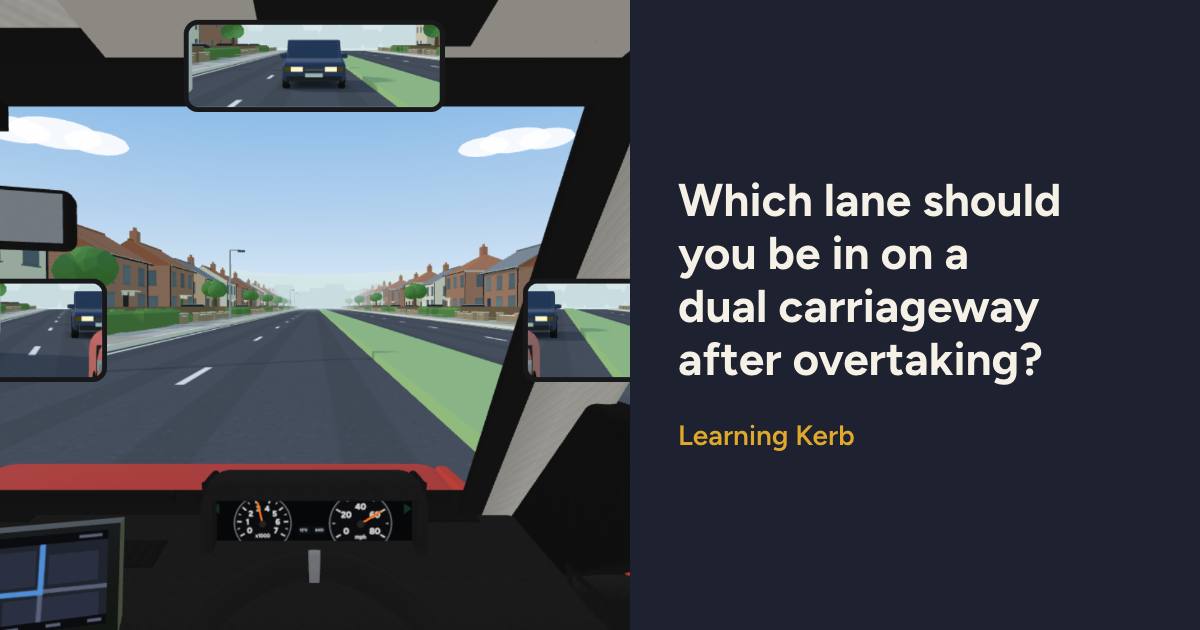
How to judge when you are far enough past
Moving back as soon as you are past the other vehicle can leave only a few metres between you, and you may force its driver to slow down.
A simple test is your interior mirror. Wait until you can see the whole of the vehicle you overtook in it. Then take these steps in order:
- Use your mirrors, with a quick sideways glance if necessary.
- Make sure you will not force anyone to change course or speed.
- Signal when it is safe to do so.
- Move over when it is clear.
Why you should not stay in the right lane
You may want to stay out if there is another slow vehicle further ahead. If the left lane is clear, though, the right lane is doing nothing for you, and it may be blocking a faster car coming up behind. Check your mirror as you finish overtaking, so you know if one is on its way.
DVSA gives unnecessarily driving in the right-hand lane of a dual carriageway for a considerable length of time as an example of poor positioning. The Code’s wording is “should”, so this is advice. On a dual carriageway with three or more lanes, the Code says you should return to the middle lanes and then the left-hand lane when it is safe to do so.
How we mark each mistake
Practice marks only: on a real test, the examiner decides. How faults work.
You cut in on the van Serious fault
You moved back with only a few metres between you and the van. Make sure you will not force anyone to change course or speed: wait until you can see the whole van in your interior mirror before you move back.
You stayed in the right lane Driving fault
On a two-lane dual carriageway you should stay in the left lane and use the right lane for overtaking. After overtaking, move back to the left lane when it is safe, especially with faster traffic behind you.
What the Highway Code says
Where this fits on the test
Top 10 fail reason: poor positioning on the road during normal driving. DVSA driving skills: Dual carriageways, Safe positioning.