What is the two-second rule in the rain?
Double it: leave at least four seconds on a high-speed road, and more room than usual on any wet road. In wet weather, stopping distances will be at least double those on dry roads, because your tyres have less grip, so the two-second gap should be at least doubled. In heavy rain and spray, keeping well back also helps you see further ahead.
You know the rule. Can you spot it on the road?
Try it in a free scene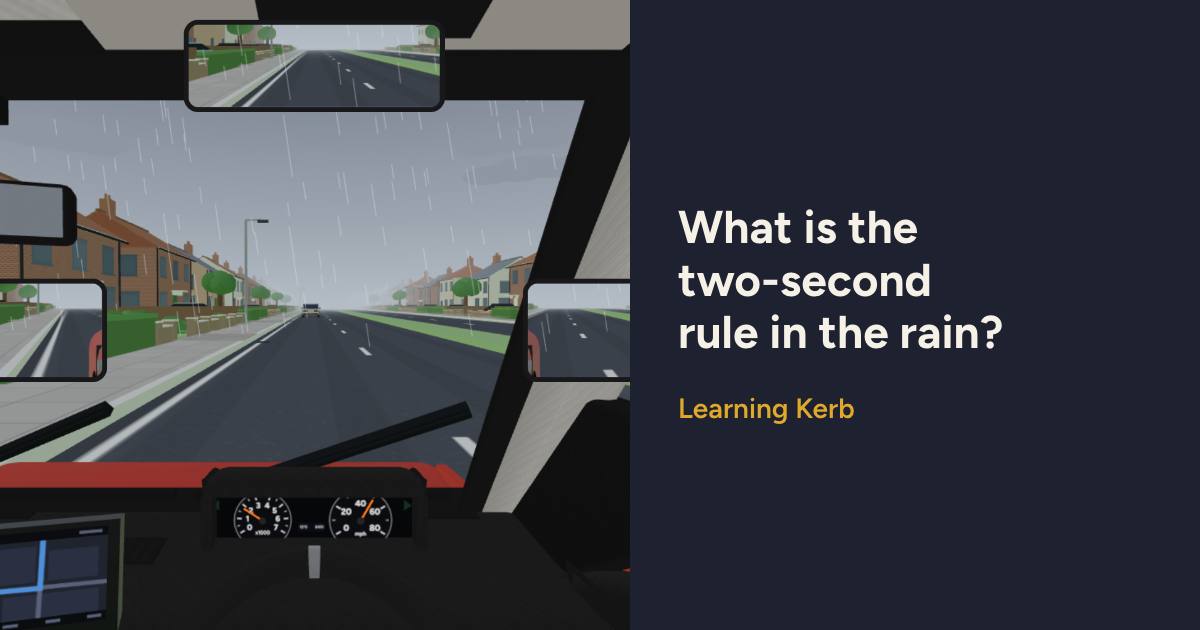
Two seconds is a dry-road minimum
The two-second rule is easy to remember, but on its own it is not enough in the rain. Rule 126 gives two seconds as the least to allow on high-speed roads, and DVSA describes it as a gap for dry conditions. As soon as the road is wet, double it. Four seconds is the starting point, and more is fine. On icy roads the Code says the gap can need to be up to ten times greater.
Having stopped in time from two seconds once does not make it a safe gap. It means the car in front gave you enough warning on that occasion. Not adjusting your distance for rain is a common fault.
Why closing up in the rain goes wrong
Closing up to stop others cutting in, or to follow the car ahead through the spray, works against you. Rain and spray make it harder to see and be seen, and keeping well back helps you see and plan ahead. Stopped traffic can be hidden until the driver ahead brakes hard, and with less grip you may have no chance of stopping in time.
Tailgating is dangerous, intimidating and can cause collisions, and the Code says the police enforce it as an offence.
Other things to change when it rains
A bigger gap is the main job, but heavy rain asks for more than that:
- Lower your speed to suit the conditions.
- If visibility is seriously reduced, generally when you cannot see for more than 100 metres, you MUST use headlights.
- If the steering becomes unresponsive, water is probably stopping the tyres gripping. Ease off the accelerator and slow down gradually.
- Take extra care around pedestrians, cyclists, motorcyclists and horse riders.
How we mark each mistake
Practice marks only: on a real test, the examiner decides. How faults work.
You were too close to stop Dangerous fault
Traffic ahead had stopped and the car in front braked hard. On a wet road your tyres have less grip, and you were too close to stop in time. Leave at least double the two-second gap when the road is wet.
Your gap was not doubled for the rain Driving fault
You stopped in time on this occasion, but two seconds is the minimum on a dry road. In wet weather stopping distances are at least double, so the gap should be at least doubled as well.
What the Highway Code says
Where this fits on the test
Top 10 fail reason: not driving at a safe and reasonable speed. DVSA driving skills: Weather conditions, Use of speed, Dual carriageways.