Do you have to stop for someone waiting at a zebra crossing?
You should give way to them, even before they step out. The Highway Code says you should give way to people waiting to cross at a zebra, and you MUST give way once someone has moved onto the crossing. Only the second is worded as a legal requirement, so plan to stop for both.
You know the rule. Can you spot it on the road?
Try it in a free scene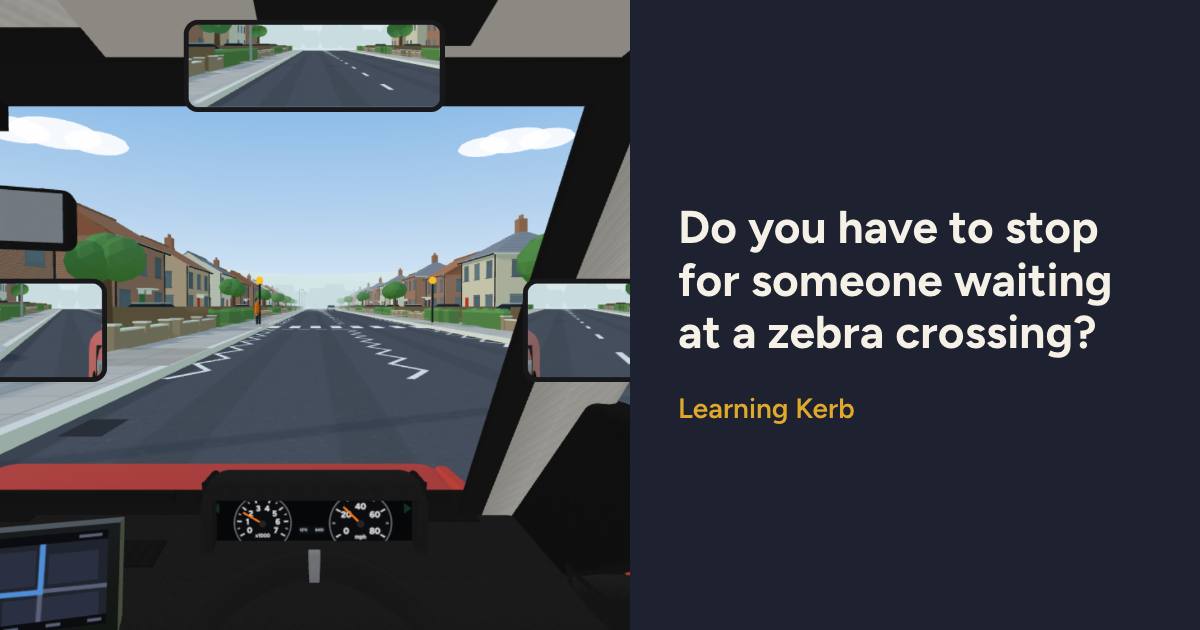
Waiting at the kerb and standing on the crossing are treated differently
The Code uses “should” for a person waiting and “MUST” for a person on the crossing, so only the second is worded as a legal requirement. That does not make the first optional. The Code says its advice can still be used in evidence in court, and giving way to people waiting is what it asks of every driver.
Someone at the kerb can step out as you arrive. If you kept your speed up because they were still waiting, you may not be able to stop, and by then they are on the crossing and the MUST applies. So plan to give way from the moment you see them.
How to approach a zebra so you can stop
DVSA’s common faults at crossings include coming in too fast, stopping on the crossing and moving off too soon. To avoid all three, and approach one well:
- Look well ahead for anyone waiting, and for anyone walking up from the side of the crossing.
- Slow down early, and allow more time on wet or icy roads.
- Stop before you reach the crossing.
- Wait until they have completely cleared it before you move off.
- Treat a zebra with a central island as two separate crossings.
- You MUST NOT overtake the vehicle nearest the crossing, whether it is moving or has stopped to give way.
Why waving someone across is a bad idea
However polite it is meant to be, you can only speak for your own side of the road. A car coming the other way may not stop, and someone who trusts your wave could walk into its path. The Code says not to wave, flash your lights or use your horn to invite people across. Stop, wait, and leave the decision to them. Be patient as well: sounding your horn or revving your engine can be intimidating.
How we mark each mistake
Practice marks only: on a real test, the examiner decides. How faults work.
You did not give way at the crossing Dangerous fault
The person waiting stepped onto the crossing as you arrived, and you could not stop in time. You should give way to people waiting to cross at a zebra, and you MUST give way once they have moved onto it.
You waved them across Serious fault
Stopping was right, but do not wave, flash your lights or use your horn to invite people across. A car was coming the other way, so your wave could have sent them into its path.
What the Highway Code says
- Rule 195:
you should give way to pedestrians waiting to cross
MUST and MUST NOT are the law. Should is advice, which can still be used in evidence in court.
Where this fits on the test
DVSA driving skills: Pedestrian crossings.