Do you have to give way to a bus pulling out?
Not by law, but you should if you can. The Highway Code says to give priority to buses when you can do so safely, especially when they signal to pull away from stops. There is no MUST in that rule, so it is advice. Slow down, let the bus go, and look out for passengers crossing.
You know the rule. Can you spot it on the road?
Try it in a free scene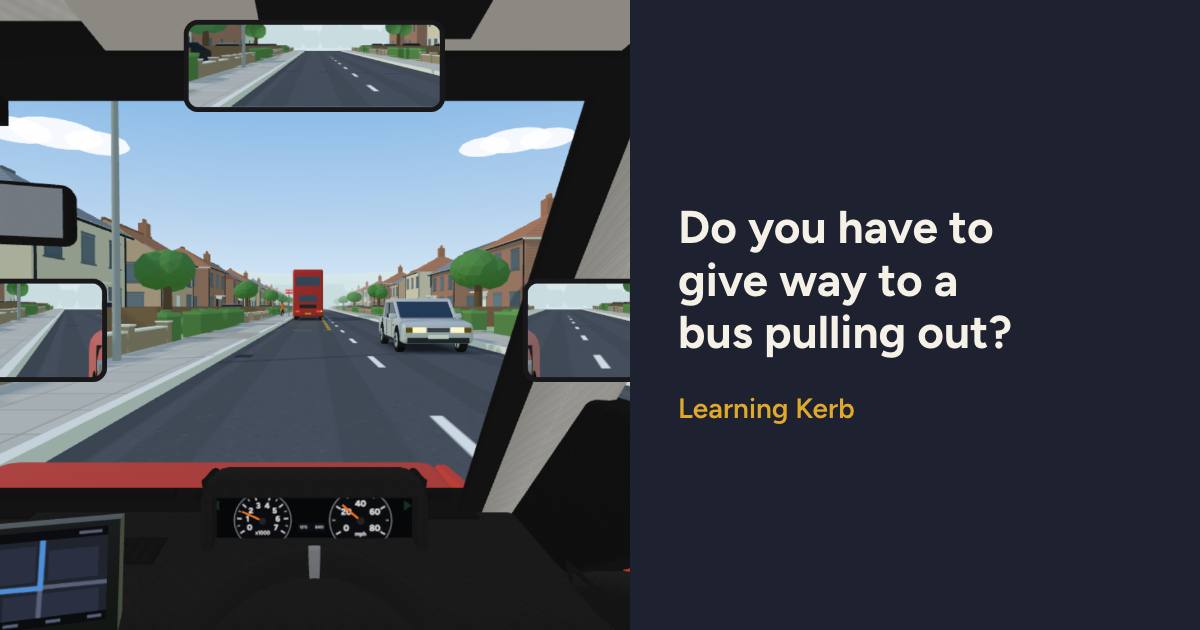
What Rule 223 does and does not say
Two parts of the wording matter. “Give priority” tells you what the Code wants from you. “When you can do so safely” is the limit on it. If you are already too close to stop smoothly, or a sudden stop would cause a problem behind you, you are not being told to do it anyway. When you have seen it signalling in good time, you can slow down gently and let it go.
Racing past the bus is the real danger
Getting past before it moves would save you sitting behind it, but the risks stack up quickly:
- The bus is indicating right. Rule 167 says not to overtake when a road user is indicating right.
- A double-decker hides whatever is in front of it, and people who have just got off may be crossing there.
- Rule 206 warns that pedestrians may emerge suddenly near bus stops, so drive carefully and slowly past them.
- At 30 mph you may not be able to stop if someone steps out from the front of the bus.
Letting the bus out without flashing your lights
It is tempting to flash your headlights to say “go ahead”, but the Code gives that signal only one meaning: I am here. The bus driver, or a passenger crossing, could take it to mean something you did not intend. Rule 111 says the same from the other side: never assume flashing headlights are an invitation to go.
You do not need a signal. Slowing down and leaving a clear gap shows the bus driver what you are doing, and it gives you time to watch for anyone crossing.
How we mark each mistake
Practice marks only: on a real test, the examiner decides. How faults work.
You overtook a bus signalling to pull away Dangerous fault
A passenger who had just got off stepped out from in front of the bus, where it hid them, and at 30 mph you could not stop. Do not overtake a vehicle that is signalling right: give a bus priority when you can do so safely, and drive slowly past bus stops.
You flashed your headlights to send a message Driving fault
Letting the bus go first was right, but only flash your headlights to let other road users know that you are there. Do not use them to tell someone to go: the driver, or the passenger crossing, could take them to mean something you did not intend.
What the Highway Code says
- Rule 223:
Give priority to these vehicles when you can do so safely, especially when they signal to pull away from stops.
- Rule 167:
when a road user is indicating right, even if you believe the signal should have been cancelled
- Rule 206:
driving past bus and tram stops; pedestrians may emerge suddenly into the road
- Rule 110:
Only flash your headlights to let other road users know that you are there.
- Rule 111:
Never assume that flashing headlights is a signal inviting you to proceed.
MUST and MUST NOT are the law. Should is advice, which can still be used in evidence in court.
Where this fits on the test
DVSA driving skills: Other traffic, Anticipation and planning, Signals.