Where can you pull up on your driving test?
Pull up in the first safe, legal place you reach: close to the kerb, clear of driveways and not opposite or within 10 metres of a junction. The choice is yours, so look for a stretch of kerb where your car will not get in anyone’s way or be a hazard to other road users.
You know the rule. Can you spot it on the road?
Try it in a free scene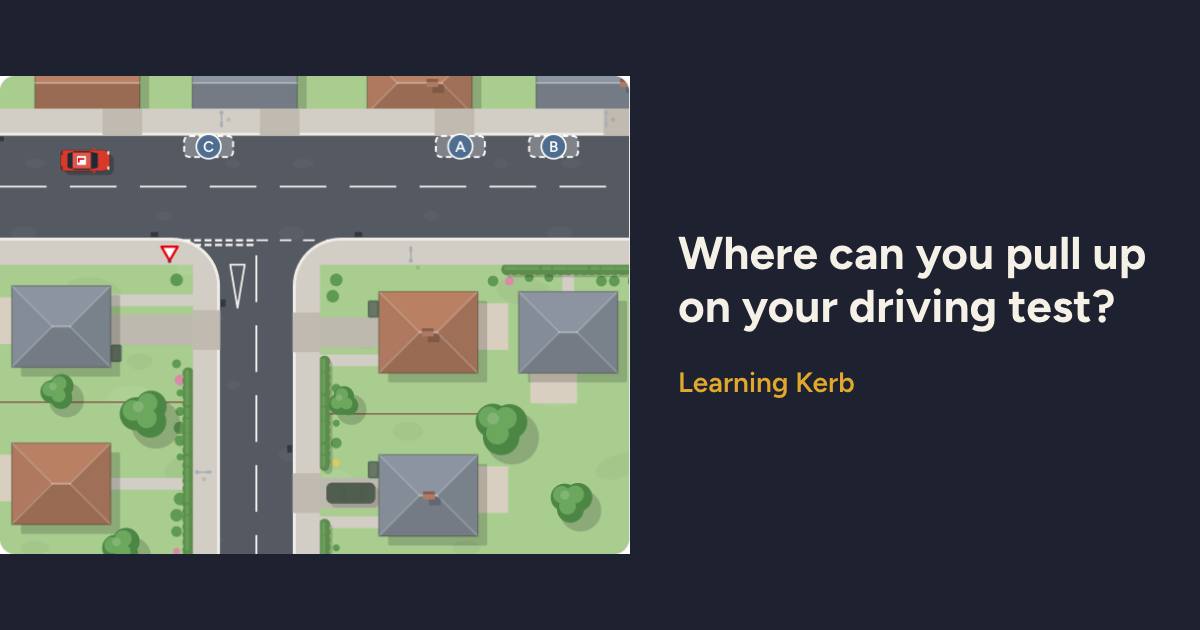
You pick the spot, so start looking straight away
When the examiner asks you to pull up on the left, the decision is yours. GOV.UK says it needs to be the first safe place available, and that once parked your car should not be a hazard to other road users. So as soon as you are asked, look along the kerb ahead for what could get in the way.
Look across the road as well. A side road on the far side still counts, because the Highway Code says not to stop opposite a junction as well as near one. A parked car there narrows the road where drivers need room and a clear view to turn.
Some places are ruled out by law. The Highway Code says you MUST NOT stop or park on a pedestrian crossing, including the area marked by the zig-zag lines, on a clearway, on a cycle track, or on a road marked with double white lines except to pick up or set down passengers, or to load or unload goods. You MUST NOT wait or park on yellow lines during the times of operation shown on nearby time plates, and double yellow lines mean no waiting at any time.
Places Rule 243 says not to stop
Here are some from the list, which applies except when stationary traffic forces you to stop:
- opposite or within 10 metres (32 feet) of a junction, except in an authorised parking space
- in front of an entrance to a property
- near a school entrance
- at or near a bus or tram stop or taxi rank
- on a bend
- near the brow of a hill or hump bridge
- where the kerb has been lowered to help wheelchair users and powered mobility vehicles
Once you have found your place
Rule 239 says to stop as close as you can to the side. The common faults for normal stops are partially or completely blocking a driveway, obstructing other road users, parking with one or more wheels on the pavement and parking too far from the kerb.
In Scotland you MUST NOT double park or park anywhere the kerb has been lowered to help pedestrians or cyclists, with exceptions in limited circumstances.
To practise, work on spotting safe and legal places to stop, and on stopping on a hill or gradient.
How we mark each mistake
Practice marks only: on a real test, the examiner decides. How faults work.
You stopped opposite a junction Serious fault
Stopping here makes it harder for drivers to turn in and out of the side road. Do not stop opposite or within 10 metres of a junction.
You stopped across a driveway Driving fault
Your car is blocking the entrance to a property. Choose a stretch of kerb where you are not in anyone’s way.
What the Highway Code says
Where this fits on the test
DVSA driving skills: Parking.