How do you pass a horse on the road?
Slow down to a maximum of 10 mph as soon as you see the horse. Wait behind it until it is safe, then pass wide and slow, allowing at least 2 metres of space. Do not sound your horn or rev your engine, because a startled horse can move suddenly.
You know the rule. Can you spot it on the road?
Try it in a free scene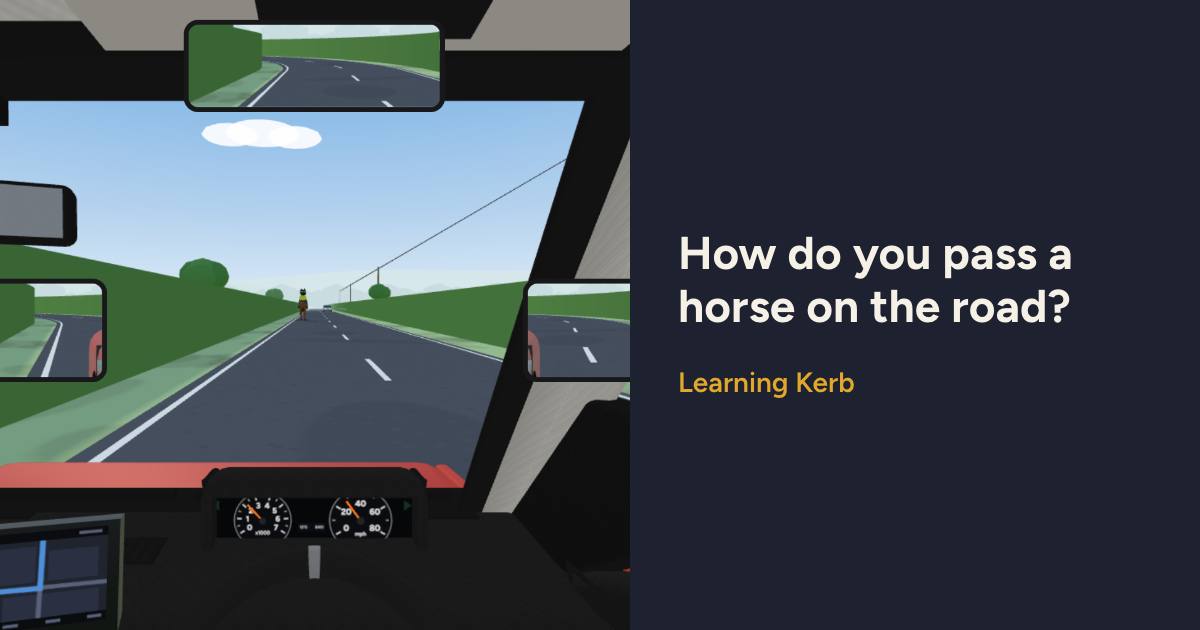
Why a horse is unlike anything else you overtake
A cyclist decides where to go. With a horse there is a rider and an animal, and the animal may decide for itself. Horses are flight animals and can move incredibly quickly if startled, so the Code says to treat all horses as a potential hazard, however well the rider is doing. That is the reason for all the extra room: it allows for the horse stepping sideways towards you.
Riders are often children, too, and they may ride in double file when escorting a young or inexperienced horse or rider. If a rider signals you to slow down or stop, do what they ask.
On a narrow lane with a car coming
A lane between hedges may not have room for a horse, your car and an oncoming car at the same moment. If you cannot give the full 2 metres, wait. Slow right down and let the car go by, however slowly the horse is walking.
Do not try to tell the rider you are there with your horn. The noise can startle the horse, and it may shy out into the road. Rule 215 has no MUST in it, so this is advice. The Code says its advice can still be used in evidence in court, so treat it as the way to drive.
Going past, and moving away
The Code asks for particular care when passing a horse and when moving away from it:
- Stay wide and keep your speed low the whole way past.
- Do not accelerate rapidly once you have passed them.
- Give feral or semi feral ponies, such as those in the New Forest, the same consideration.
How we mark each mistake
Practice marks only: on a real test, the examiner decides. How faults work.
You passed the horse too close and too fast Dangerous fault
With a car coming the other way there was no room to pass the horse wide. Slow down to 10 mph or less when you see a horse, and wait until you can pass wide and slow, allowing at least 2 metres.
You sounded your horn at a horse Serious fault
The noise startled the horse, which shied out towards the middle of the road. Be patient behind a horse rider: do not sound your horn or rev your engine.
What the Highway Code says
- Rule 215:
When safe to do so, pass wide and slow, allowing at least 2 metres of space.
- Rule 214:
Do not scare animals by sounding your horn, revving your engine or accelerating rapidly once you have passed them.
MUST and MUST NOT are the law. Should is advice, which can still be used in evidence in court.
Where this fits on the test
Top 10 fail reason: not driving at a safe and reasonable speed. DVSA driving skills: Other traffic, Country roads, Use of speed.