Where should you pull over for an ambulance?
Pull over only where the ambulance has room to get by, and try to avoid stopping before a bend, a narrow section or the brow of a hill. First stay calm and work out where it is. Let it pass while still obeying all traffic signs, and avoid mounting the kerb.
You know the rule. Can you spot it on the road?
Try it in a free scene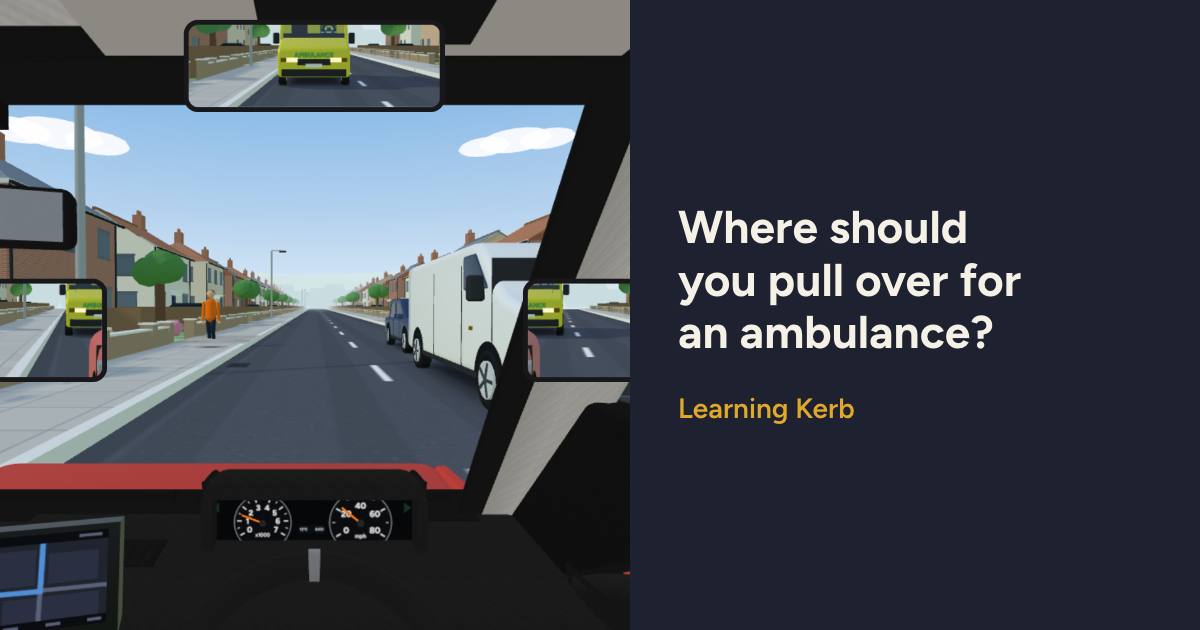
Find it before you do anything
A siren tells you something is near. It does not tell you where it is or where it is going. Look and listen first. Check your interior mirror, which shows best what is right behind you, then your door mirrors. Then think about the route it is likely to take, because you can only help once you know that. Rule 219 says the same: look and listen, do not panic, and consider the route of the vehicle.
The nearest place to stop may be the wrong place
Pulling over at once can make things worse. If a van is parked opposite you, stopping there leaves the road too narrow, and the ambulance ends up stuck behind you. Look ahead for where the road opens out. Keeping going for a few more seconds to reach that spot gets it past you sooner.
Think about the ambulance’s width as well as your own. It needs a clear path beside your car and whatever is on the other side of the road.
What a siren does not change
Rule 219 has no MUST of its own, so its wording is advice. That does not switch off the signs around you: you MUST still obey traffic light signals and traffic signs giving orders. Rule 219 also sets out some clear limits:
- Keep complying with all traffic signs while you let it pass.
- Do not endanger yourself, other road users or pedestrians.
- Avoid mounting the kerb. Someone may be walking along the pavement, and you could drive into their path.
- Do not brake harshly on the approach to a junction or roundabout, as a vehicle following you may not have the same view as you.
How we mark each mistake
Practice marks only: on a real test, the examiner decides. How faults work.
You drove onto the pavement Dangerous fault
Someone was walking along the pavement, and you drove into their path. Let an emergency vehicle pass without endangering pedestrians or anyone else, and avoid mounting the kerb.
You stopped where it could not pass Serious fault
With a van parked opposite, the road was too narrow for the ambulance to get by, so it was held up behind you. Try to avoid stopping at or just before a narrow section of road: pull in where it can pass.
You did not check your interior mirror Driving fault
When you hear a siren, look and listen to work out where the emergency vehicle is. The ambulance was right behind you, where your interior mirror shows best.
What the Highway Code says
- Rule 219:
If necessary, pull to the side of the road and stop, but try to avoid stopping before the brow of a hill, a bend or narrow section of road.
MUST and MUST NOT are the law. Should is advice, which can still be used in evidence in court.
Where this fits on the test
Top 10 fail reason: not using mirrors correctly when changing direction. DVSA driving skills: Other traffic, Mirrors, Safe positioning.