What do you do at a half barrier level crossing?
Stop behind the white line when the amber light comes on, and stay there while the red lights flash: you MUST obey them. If a train goes by and they keep flashing, another train is coming, so you MUST wait. Only cross when the lights go off and the barriers open.
You know the rule. Can you spot it on the road?
Try it in a free scene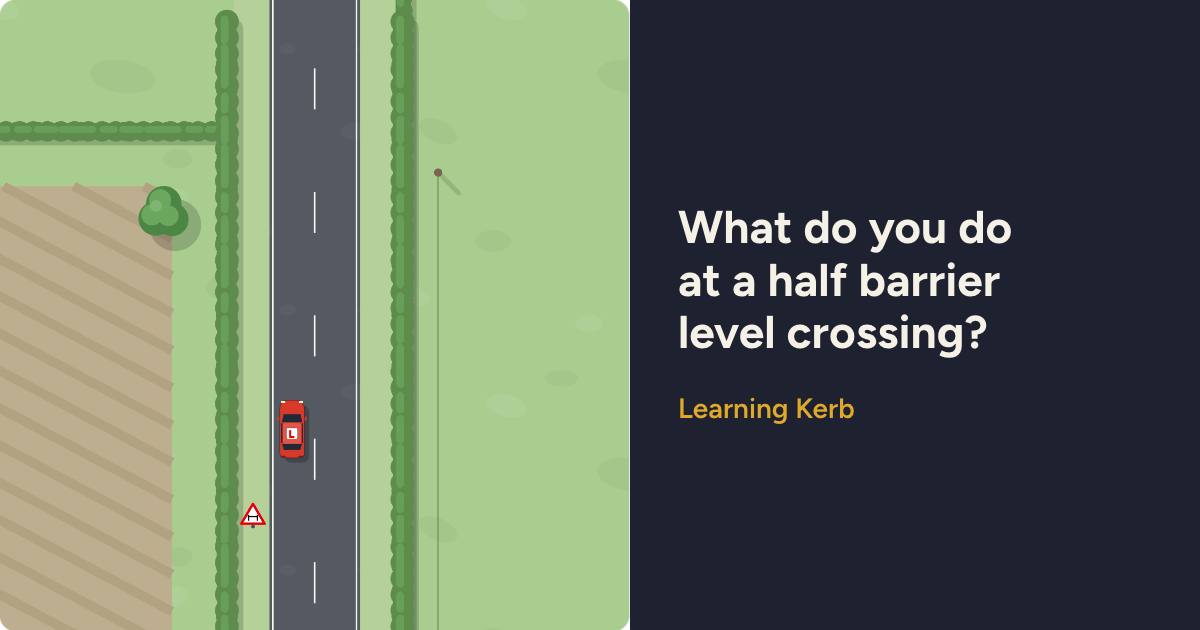
What each stage means for you
A controlled crossing warns you in order, so work out where you are in it:
- Steady amber comes on. You MUST stop behind the white line. The one exception is if you have already crossed the line, in which case keep going.
- Twin red lights flash. You MUST obey the lights, and the barriers lower automatically because a train is approaching.
- A train goes by and the red lights keep flashing. You MUST wait, because another train will be passing soon.
- The lights go off and the barriers open. Now you can go, as long as the road is clear on the other side.
Why a gap beside the barrier is not a way through
A half barrier leaves room to drive round it, and after a train has passed the track can look empty. That is when people are tempted. The Code says never to zig-zag around half barriers, and the flashing lights are telling you a train is due, whatever you can see along the line.
Creeping up to the barrier so you are ready to go gains you nothing either. It takes you past the white line and closer to the railway.
While you wait, and when you go
If you are stopped for a long time, DVSA suggests considering stopping the engine. Do not reverse onto or over the crossing, and do not overtake at it.
When it reopens, leave room in front of you. Never drive onto a crossing until the road is clear on the other side, and never stop on it.
How we mark each mistake
Practice marks only: on a real test, the examiner decides. How faults work.
You went round the barriers Dangerous fault
Never zig-zag round half barriers. You MUST wait while the red lights keep flashing after a train goes by: it means another train is coming.
You did not stop for the lights Serious fault
You MUST stop behind the white line, unless you had already crossed it when the amber light came on. You had room to stop, but drove on as the red lights began to flash, and you MUST always obey those.
You moved past the white line Serious fault
You MUST stop behind the white line while the red lights flash. Moving up to the barrier puts you closer to the railway, with no gain.
What the Highway Code says
- Rule 291:
Never drive onto a crossing until the road is clear on the other side
- Rule 293:
You MUST wait if a train goes by and the red lights continue to flash. This means another train will be passing soon.
MUST and MUST NOT are the law. Should is advice, which can still be used in evidence in court.
Where this fits on the test
Top 10 fail reason: not responding appropriately to traffic lights. DVSA driving skills: Anticipation and planning, Moving away and stopping.