Can you go through an amber light?
Only if you have already crossed the stop line or are so close to it that stopping might cause a collision. Amber means stop, so otherwise stop at the first white line. Being able to get through before red is not one of the two cases.
You know the rule. Can you spot it on the road?
Try it in a free scene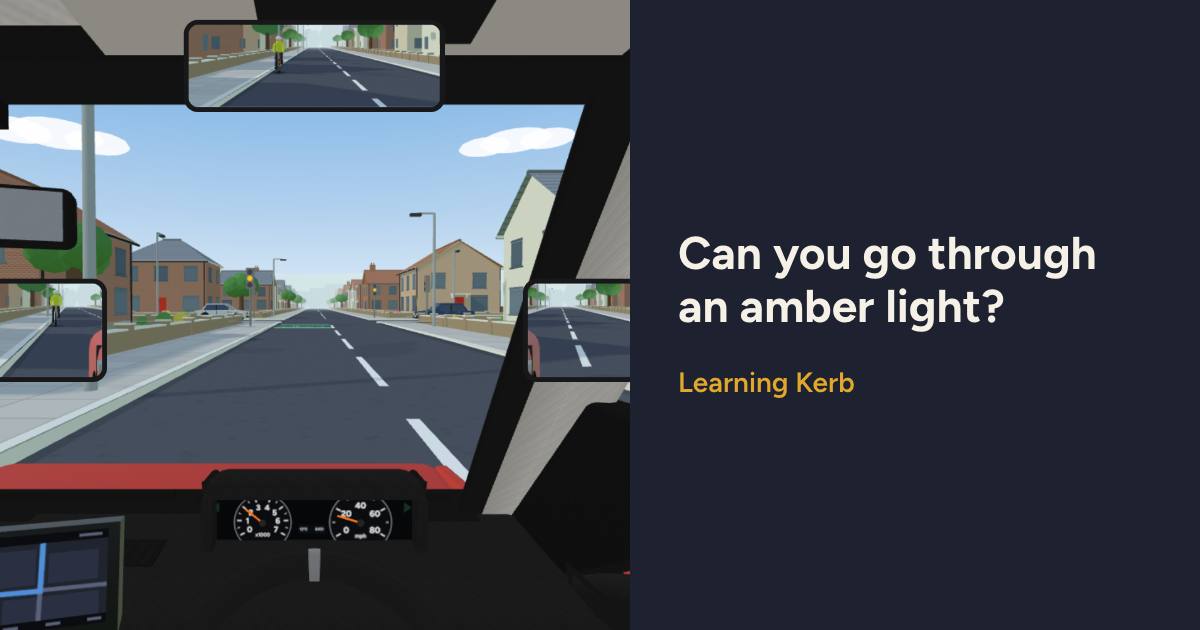
The two questions to ask on amber
Whether you would clear the junction before red does not come into it, and neither does whether anyone is waiting at the other lights.
Take a car doing 20 mph, about seven car lengths from the line when the light changes. There is room to stop safely, so the driver stops. Run through this as soon as the light changes:
- Have I already crossed the stop line? If so, carry on, but if there is a second line and the light goes red first, stop there.
- Am I so close that stopping might cause a collision? If so, carry on.
- If the answer to both is no, stop.
Which line to stop at when there are two
Some lights have a second white line further on, with a box between the two so that cyclists can wait ahead of other traffic. Stopping at the second line to get nearer the front puts you in their space. On amber or red you MUST stop at the first white line you reach, and DVSA lists stopping beyond it among its examples of not responding properly to traffic lights.
If you were already over the first line when the light went red, you should stop as soon as possible and you MUST stop at the second line. When the light goes green, allow cyclists enough time and space to move off.
What about red and amber together?
The amber that comes after red gives you no early start. You MUST stop behind the white line unless the light is green, so stay where you are until it is. Then go only if the way is clear and there is room for you to clear the junction safely, or you are taking up a position to turn right.
How we mark each mistake
Practice marks only: on a real test, the examiner decides. How faults work.
You went through when you could have stopped Serious fault
You had room to stop safely, and the lights were red before you cleared the junction. On amber you may go on only if you have crossed the line or are too close to stop safely.
You stopped in the cycle box Serious fault
You MUST stop at the first white line reached if the lights are amber or red. The space beyond it is for cyclists to wait ahead of other traffic.
What the Highway Code says
- Rule 109:
You MUST obey all traffic light signals
- Rule 175:
If the amber light appears you may go on only if you have already crossed the stop line or are so close to it that to stop might cause a collision.
- Rule 176:
You MUST NOT move forward over the white line when the red light is showing.
- Rule 178:
Motorists, including motorcyclists, MUST stop at the first white line reached if the lights are amber or red
MUST and MUST NOT are the law. Should is advice, which can still be used in evidence in court.
Where this fits on the test
Top 10 fail reason: not responding appropriately to traffic lights. DVSA driving skills: Junctions, Anticipation and planning.