How fast should you drive past parked cars?
Slowly enough to stop well within the distance you can see is clear, which can mean well below the limit. Cover the brake and keep watching for anything that could appear between the cars. A 30 limit does not make 30 safe here. If cars are parked ahead on your side and something is coming, you should give way and hold back, in a gap if there is one.
You know the rule. Can you spot it on the road?
Try it in a free scene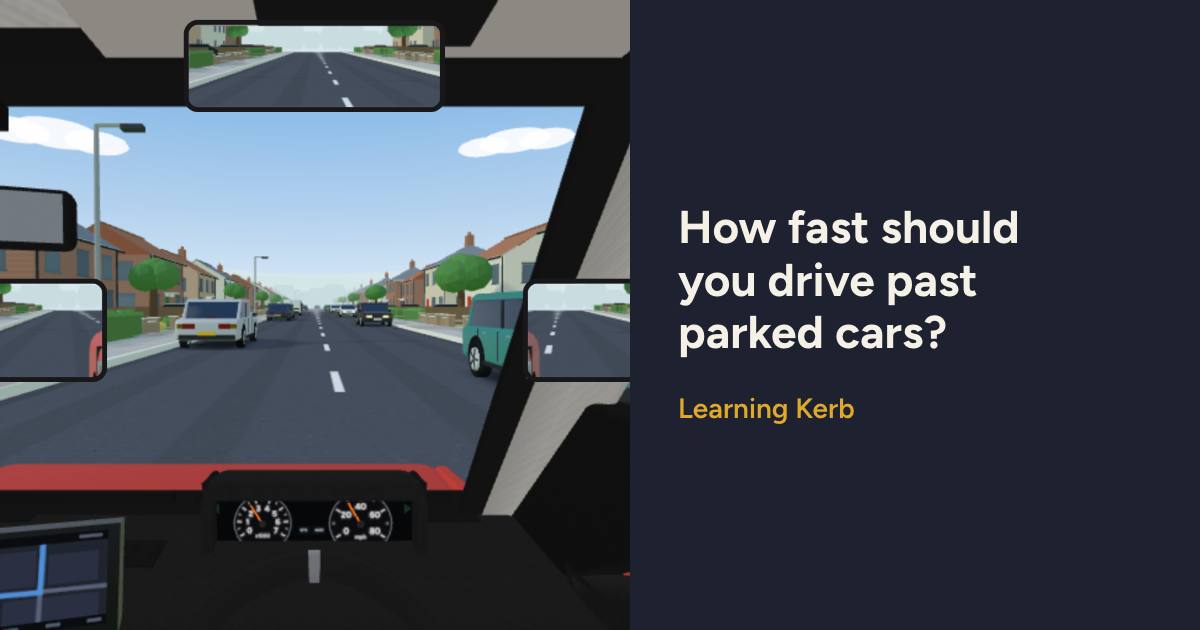
Why 30 can be too fast on a 30 road
Treat the limit as the absolute maximum and never as a target. With cars lined up on both sides you cannot see between them, so someone could step out with very little warning. You need a speed that lets you stop safely, well within the distance you can see is clear.
There is no set number. It depends on how far you can see and who is about. In a tight street with no view between the cars, about 15 mph with your foot over the brake gives you a chance of stopping if a child runs out. Speeding up to get clear of the parked cars sooner does the opposite. Once the road opens up, build your speed back up: DVSA lists driving well below the speed limit on clear roads as a common fault. A 20 mph limit may also be in force in some areas, and generally applies on roads with street lights in Wales, so keep reading the signs.
What could come out from the parked cars
Rule 152 lists what to look out for on residential streets. Keep these in mind as you go:
- Children running out from between parked cars.
- Car doors opening.
- Vehicles moving off, or coming out of junctions and driveways.
- Pedestrians, cyclists and motorcyclists.
Who goes first when the gap is too narrow
If the parked cars are on your side, you should give way to the oncoming vehicle, so spot a gap early and hold back in it, or hold back before the parked cars if there is no gap. If cars are parked on both sides at that point, neither of you has a clear right to go first, so be ready to give way and never assume the other driver will.
How we mark each mistake
Practice marks only: on a real test, the examiner decides. How faults work.
Too fast to stop for a child Dangerous fault
A child ran out from between parked vehicles and you could not stop in time. The speed limit is the absolute maximum; drive slowly where there are parked cars and people about.
You did not give way Dangerous fault
The parked cars were on your side, and the oncoming driver had to brake hard. You should give way to oncoming vehicles before passing parked vehicles or other obstructions on your side of the road.
What the Highway Code says
- Rule 125:
The speed limit is the absolute maximum and does not mean it is safe to drive at that speed irrespective of conditions.
- Rule 152:
You should drive slowly and carefully on streets where there are likely to be pedestrians, cyclists and parked cars.
- Rule 163:
give way to oncoming vehicles before passing parked vehicles or other obstructions on your side of the road
- Rule 205:
You should drive with the safety of children in mind at a speed suitable for the conditions.
MUST and MUST NOT are the law. Should is advice, which can still be used in evidence in court.
Where this fits on the test
Top 10 fail reasons: not driving at a safe and reasonable speed, poor positioning on the road during normal driving, not having proper control of the steering. DVSA driving skills: Use of speed, Safe positioning, Other traffic.